Preamble of the RTI Act:
“An Act to provide for setting out the practical regime of right to information for citizens to secure access to information under the control of public authorities, in order to promote transparency and accountability in the working of every public authority, the constitution of a Central Information Commission and State Information Commissions and for matters connected therewith or incidental thereto.”
What should an SPIO do when he receives an RTI Application?
- No need to panic – Handling RTI applications is not too difficult.
- Knowledge of the RTI Act Provisions Sections to know in particular:
- Section 2(f), (h), (i) & (j)
- Section 4
- Section 6 – Full
- Section 7 – Sub sections 1, 2, 6, 8 & 9
- Section 5(4) & 5(5)
- Section 8(1) [sub-sections (b), (d), (e) & (j), (h), (g)]
- Section 10(1)
- Section 11 [to be read with Section 8(1) (e) & (j)]
- Section 18(1) (a) to (f), 18(3) and (4)
- Section 19 (full)
- Section 20 (full)
- Section 21 & 23
- Section 22
- Section 24
West Bengal Right to Information Rules, 2006 (as amended in 2008)
Rule 3 – Application Money – Court fee, NJ Stamp, DD, Banker’s cheque, IPO (No fee for BPL Category)
Rule 4 – Photocopy charges – Rs. 2 per page etc. No charge after exceeding 30 days [Section 7(6)]
Exempted Organizations [section 24(4)] – Notification Date: 29.8.2006
RTI Act – Intended Outcomes:
- Opportunity to streamline storge and retrieval of Records.
- The RTI Act requirements can spur digitization of records and their placing in public domain in accordance with Section 4 of the RTI Act.
- Increased Information disclosure will lead to less employee/public grievances.
- Accountability of the Staff in their work disposal.
- The supervisory authorities by reviewing RTI disposal can look for system improvements. A legal role has been assigned in the RTI Act to the the supervisory authorities being designated as First Appellate Authority (FAA) precisely for this purpose.
Section 2 – Important Provisions:
- Section 2(h) – Whether the information sought pertains to a public authority or not. If the information sought is about non-public authority, there is no obligation on part of the SPIO. However, a reply to the effect should be sent to the applicant.
- “Information” defined in Section 2(f); “Record” defined in 2(i) & “Right to Information” in 2(j) and also in Section 3.
- As a general rule, Information can only be furnished which is “information accessible (under the RTI Act), which is held by or under the control of any public authority.” [Section 2 (f)]
What to do when Information is neither available nor accessible/under control of the SPIO or only part information is available
- Inform the appellant within stipulated time [Section 7(1) – 30 days] that it is neither available nor accessible/under control.
- If it is known to be with some other public authority – Transfer under Section 6(3) within 5 days under intimation to the RTI applicant. Part transfer is also allowed.
- If no transfer/part transfer done and transfer time has lapsed, seek information from any SPIO/official by issuing a formal notice under Section 5(4) under intimation to the RTI applicant. Mention in the said notice that such SPIO/official will be “deemed SPIO” for the case for all the obligations under the RTI Act [Section 5(5)]
- Reply to be collected and furnished in such case by SPIO to whom RTI application was filed.
Suo Moto disclosure under Section 4
- All public authorities obligated to suo moto disclose all information stipulated under Section 4(1) in the public domain, preferably on the website/portal initially and then keep on revising/supplementing [Section 4(2)].
- Once information is already in the public domain, no need to furnish/repeat the same in reply to an RTI application. But, a reply has to be sent stating so and giving website/portal link to access such information.
- If part information is in public domain and rest with the public authority/others, reply has to be furnished accordingly.
- Suo moto disclosure of as much information as possible in public domain saves time, energy and hassle of SPIO and others & promotes transparency – the main objective of the RTI ACT.
Next Steps after receiving RTI application
- Scrutinize whether signed, address given [required for sending reply – Section 6(2)] & fee rendered. Copy of BPL card, if fee waiver claimed. Email, mobile not mandatory but can help in communicating. Email applications also acceptable.
- SPIO can seek further details in case of – doubtful identity, doubt about citizenship, applicant appears pseudonymous.
- Signed by multiple persons – ground for rejection as RTI can be filed only by “A Person” u/s 6(1).
- Signed as office bearer of some organization and/or on the letter pad of such organization containing address. Name and address only to be used for the purpose of RTI application.
- Advocate filing on behalf of client – If accompanied by Vakalatnama/ signed by client on the body of the application, to be treated as RTI filed by the client. If not, Advocate will be treated as RTI applicant and information sought about client to be treated as third party/personal information.
- Incongruous, incoherent and ambiguous application can be returned back and clarification sought under Section 5(3) and proviso to Section 6(1)
- No reason required for seeking information [Section 6(2)]
- Deemed refusal, if not furnished within 30 days. SPIO can inform in the interim about information being collected and will be send in due course.
How to treat Voluminous, Ambiguous and Multiple Query RTIs
- Section 6(1) – an RTI applicant shall make ‘A Request’ to SPIO, specifying the particulars of ‘The Information’ sought. This clearly refers to a particular information rather than a plethora of information sought of varying and unrelated subjects in one application.
- Section 7 (1) – SPIO, on receipt of ‘A Request’ is expected to deal with it. The RTI applicant can not bundle a series of requests into one application to avoid paying application fee for multiple RTI applications.
- No bar on an application comprising of ‘A Question’ with several clarificatory or supporting questions.
- Section 7(9) of the RTI Act – Information to be given in format sought unless it will divert disproportionate resources of the public authority. Use this section to deny voluminous, general and vague RTI applications seeking large number of queries – with several sub-queries and often unrelated to each other.
- The SPIO is not supposed to research, collect from various sources and collate information to meet the requirement of the RTI applicant. [Section 7(9)]. Busybodies/Researchers want SPIO to do the same as per format given by them.
Ratio Decidendi on the subject by Hon’ble Supreme Court of India
- Indiscriminate and impractical demands for disclosures of information unrelated to transparency and accountability in the functioning of public authorities and eradication of corruption, would be counter-productive. It will adversely affect efficiency of administration and result in public authority getting bogged down by non-productive work of collecting and furnishing this unwanted information.
- The Act should not be allowed to be misused or abused, to become a tool to obstruct the national development and integration, or to destroy the peace, tranquillity and harmony among its citizens. Nor should it be applied as a tool of intimidation of honest officials striving to do their duty.
- The threat of penalties under RTI Act should not lead to employees of public authorities prioritizing information furnishing at the cost of the normal and regular duties.
- Where the information sought is not a part of the record of public authority nor is required to be maintained under any Law or Rules or Regulations, there is no obligations on part of the public authority to collect or collate such unavailable information and furnish it to the applicant.
- The public authority is also not required to furnish information which requires inferences and / or making of assumptions.
- The SPIO is not required to provide “advice” or “opinion” nor obtain and furnish any advice or opinion to the applicant. Section 2(f) only refers to such material (advice/opinion) as available in the records of the public authority.
CBSE Vs. Aditya Bandyopadhyay (2011), SC
Other Caveats for Replying to RTIs
- The SPIO is not supposed to furnish any clarification, explanation or interpretation on existing information/document.
- Large percentage of RTI applications are related to employee grievances and have to be treated as such.
- There is a clear distinction between a grievance petition and an RTI application. Often RTI applications are filed to settle an existing grievance.
- The SPIO/Public Authority is not required to first settle the grievance of the RTI applicant and then furnish desired information to the applicant. However, Current Status of the grievance petition can be given.
- From an RTI application seeking both and grievance redressal – take out and furnish information as available and existing and for the other part, reply that no grievance can be settled by the RTI mechanism.
- The SPIO is not supposed to reply to the question on “Why” something has been done/not done.
- The SPIO is also not supposed to reply “When” and/or “How” it will be done as both are in the realm of future for which no information exists nor is available at present. Attempting to reply to such queries will amount to the SPIO furnishing his opinion/advice.
- Most frequent query in the RTI applications is asking “Reason” for certain action/inaction of administrative authorities.
- Trying to reply to this will amount to giving justification for administrative work(clarification/explanation/interpretation) and hence not ‘information’.
- No need to reply to hypothetical question seeking advice/opinion/future course.
What are Exempted Information
Section 8 is a non-obstante clause – i.e. exemptions are unqualified, notwithstanding anything else in the RTI Act
- Personal Information – Section 8(1)(e) and (j)*
- Information held by public authority in a fiduciary capacity i.e. between employer and employee, such as academic qualification, medical record, emoluments, attendance, tax, deductions, loans and advances, family details and disciplinary proceeding records etc. not to be given to third persons (including wife/husband)
- Answer scripts of an RTI applicant himself/herself can be given but not of others (ICAI – Vs – Shaunak H. Satya & Others, Supreme Court – 2011)
- When there is threat of physical harm if personal information is disclosed, such as personal details of an examiner, govt. official etc., no information need be given [Section 8(1)(g)]. Same applies for informants.
- After enactment of Personal Digital Data Protection Act, 2023, no exception made for furnishing personal information
*Hon’ble Supreme Court in Girish Ramchandra Deshpande Vs. CIC (2013) and R. K. Jain Vs. Union of India (2013)
Section 8(1)(j) Before and After Digital Personal Data Protection Act, 2023
| Before | After |
|---|---|
| Information which relates to personal information the disclosure of which has no relationship to any public activity or interest, or which would cause unwarranted invasion of the privacy of the individual unless the Central Public Information Officer or the State Public Information Officer or the appellate authority, as the case may be, is satisfied that the larger public interest justifies the disclosure of such information: Provided that the information which cannot be denied to the Parliament or a State Legislature shall not be denied to any person. | Information which relates to personal information. |
Sub judice information: Section 8(1)(b)
- There is common misconception that sub judice information can not be furnished. There is no such stipulation in this section. It is only when a court of law expressly forbids to furnish such information, then this section applies. Information can not be denied on the pretext that the matter is in court and is sub judice.
Information impeding Inquiry, Investigation, Arrest or Prosecution: Section 8(1)(h)
- The key word is “impede” the process. Normally, during the course of court proceeding, the two sides get copies of records authorized by the law to pursue their respective positions, hence seeking same records through RTI is superfluous. However, it is for the SPIO to decide this.
- When the case is completed or finalized, there is no bar in furnishing case related information/documents as “impede” will not apply. If an appeal has been filed in a higher court and this is known to the public authority, the case is not treated as completed or finalized.
- When Case Diary is filed in court, a police official no longer has ‘control’ over case related information and hence can not furnish any such information.
Section 10 & 11
- Section 10 (1) provides for furnishing copies of documents which have both parts – disclosable and non-disclosable. In case it is possible to do so – non-disclosable information can be redacted (hidden through black ink marking etc.), and then the document can be furnished.
- Section 11 – With the removal of proviso to Section 8(1)(j), the application of this section has become redundant as third party personal information can not be furnished in any case.
Section 22 – Non-Obstante clause
Section 22: The provisions of this Act shall have effect notwithstanding anything inconsistent therewith contained in the Official Secrets Act, 1923, and any other law for the time being in force or in any instrument having effect by virtue of any law other than this Act.
- The provisions of the RTI Act shall prevail over provisions contained in any other Act/Any instrumentality under any other Act.
- This means and entails that as far as furnishing of information is concerned, anything existing in any other Act which proscribes furnishing of information has to be dis-regarded. Information can only be denied using exemptions provided in the RTI Act itself (Section 8, 9, 11).
- This also means that the same principal applies to any Instrument (Rules, Regulations, Notification, Manual, Executive Order, Guidelines, Resolutions etc.) enacted under any other Act or otherwise.
Section 22 – Furnishing of Certified Copies under any Act/Rule etc.
- The same principle as outlined in the previous slide will apply.
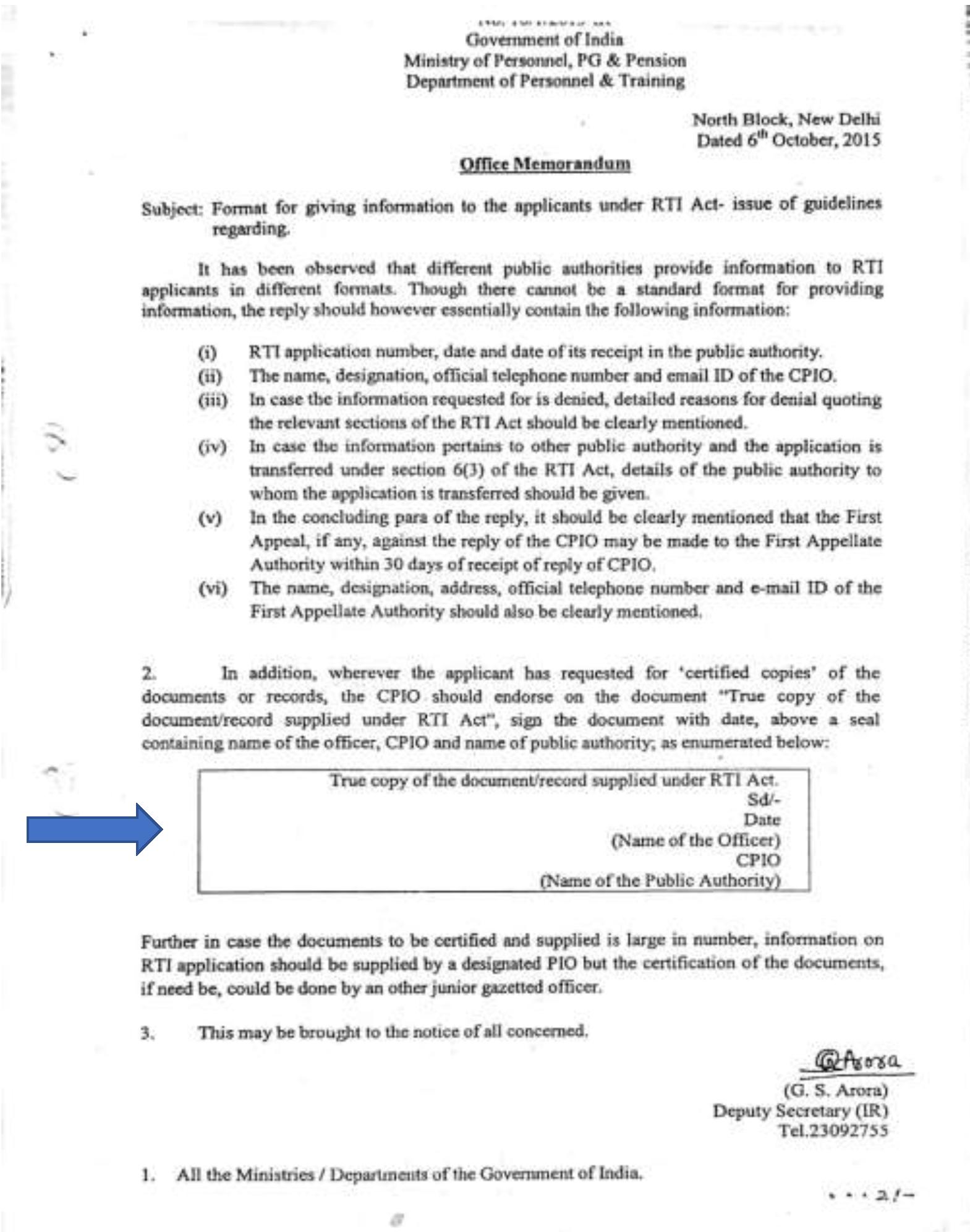
- Section 2(j) (ii) – right to get certified copy of documents or records.
- However, a distinction has to be made when “certified copy” is asked for legal purposes, the process specified under any other Act/Rule for seeking such such “certified copy” will apply.
- If such “certified copy” can be obtained from a portal/website by paying a fee or otherwise, the information stands disclosed in the public domain u/s 4 and therefore no longer available or accessible to the SPIO/Public Authority.
- However, when the RTI applicants wants a certified copy under the RTI Act, the same has to be furnished as “certified under the provisions of the RTI” Act and the document can not be denied on the ground that a separate procedure exists for obtaining the same and/or the fee payable is more in such other procedure and therefore the applicant should use the other procedure and not the RTI Act.
Section 18 & 19
- These refer to filing and disposal of Appeal (1st appeal by FAA & 2nd appeal by information Commission) and Complaint to the Commission. The grounds for filing both are similar. It is the discretion of the applicant to chose one.
- However, if complaint is filed, information can not be furnished in complaint resolution as per the ratio given by the Hon’ble Supreme Court in CIC Vs. State of Manipur (2011). However, Compensation award for any loss or other detriment [Section 18 (8) (b)] to the complainant/appellant can be made and/or penalty on SPIO [Section 20(1) or Disciplinary Proceedings {Section 20(2)] can be imposed.
- No Penalty can be imposed without giving an opportunity to the SPIO to present his case and also without establishing that the SPIO did not furnish/denied information in a mala fide manner and without any “reasonable” cause. Mere delay is not sufficient for imposition of penalty.
- The Act provides for imposition of penalty @ Rs. 250 per day, maximum being Rs. 25,000. No discretion is provided in the Act to reduce/increase the scale.
- For claiming compensation – both loss and injury due to delay/denial of information have to be proved.
- For claiming compensation – both loss and injury due to delay/denial of information have to be proved.
- Award of Compensation and Penalty are independent of each other and have to dealt separately.
- In case of recommending Disciplinary Action, the essential ingredient of repeated and persistent denial is to be established in addition to the requirements for imposition of penalty. It is a rarely used remedy.
- It may be mentioned that while compensation is to be paid by the Public Authority from its coffers, penalty is personal to the SPIO and has to be paid by himself from his own pocket.
First Appellate Authority (FAA):
- The FAA has only supervisory role to see that RTI applications are being handled by the SPIOs properly. This is the reason for him to be dealing with first appeal. In addition to directing SPIO to furnish information, FAA can himself furnish information to the appellant during the 1st appeal proceeding.
- There is no punitive measure against FAA for not disposing/delaying 1st appeal.
- The Information Commission may refuse hearing 2nd appeal if no 1st appeal was filed by the appellant in the first instance.
Legal Obligations and Protection for SPIOs
- Section 7(2) – if the SPIO does not furnish information within the prescribed period, he will be deemed to have refused the request to furnish information.
- Section 19(5) – During the hearing of appeal/complaint before the FAA/Information Commission, the onus to prove that denial of information was justified, will be on the SPIO.
- Section 21 – No suit, prosecution or other legal proceedings to lie against SPIO (and FAA & Information Commissioners) for acts done in good faith.
- Section 23 – No court to take cognizance of any suit, prosecution or other legal proceedings against any order (of SPIO, FAA & Information Commission) made under the RTI Act. No such order can be questioned except by way of appeal (or complaint) prescribed in the RTI Act.
- The High Courts in their jurisdiction and the Supreme Court can, of course, entertain such prayer on SPIO’s reply/denial and also against the orders of the FAA & Information Commission.