WEST BENGAL BOARD OF MADRASAH EDUCATION
‘Maulana Abul Kalam Azad Bhawan’
DD-45, Sector -I, Salt Lake City, Kolkata-70006
e-mail: wbbme2011@gmail.com
Memo No. 76/Aca/25 Date: 24.12.2025
NOTIFICATION
As directed, all Head of Madrasahs (recognized by WBBME) are instructed to implement the Academic Calendar-2026 for smooth functioning of day to day academic and administrative activities of all Madrasahs in the State. The same has been attached herewith for ready reference.
Secretary
West Bengal Board of Madrasah Education
Memo No. 76/Aca/25 Date: 24.12.2025
Annual Academic Calendar-2026
(1) Academic Session: 01 January, 2026 to 31 December, 2026
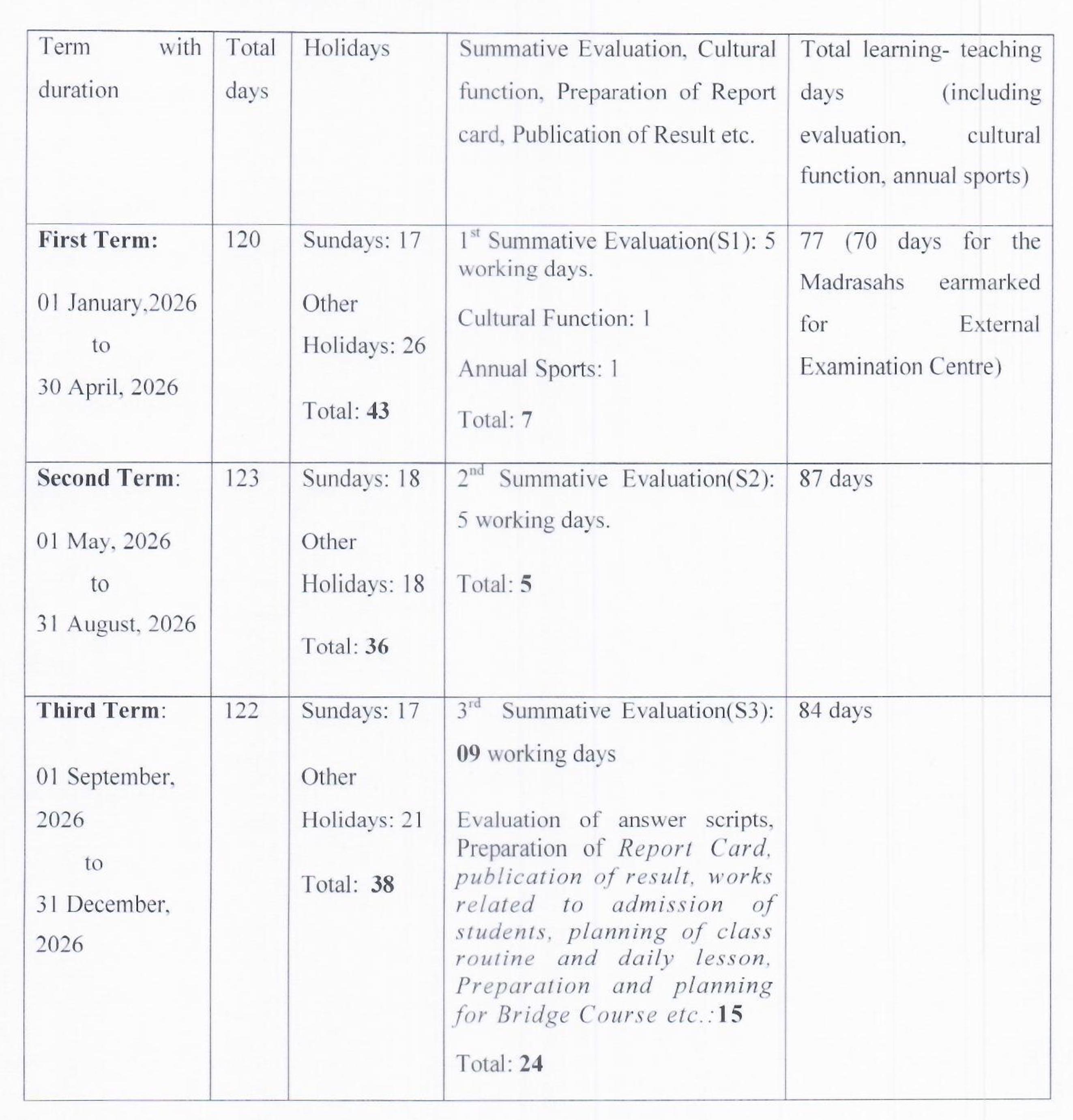
The Session will be divided into three (3) Terms as follows:
i) first Term: 01 January, 2026 to 30 April, 2026 (including 1st Formative and Summative Evaluation, Preparation of Holistic Progressive Report Card & Publication of Results etc.)
ii) Second Term: 01 May, 2026 to 31 August, 2026 (including 2nd Formative and Summative Evaluation, Preparation of Holistic Progressive Report Card & Publication of Results etc.)
iii) Third Term: 01 September, 2026 to 31 December, 2026 (including 3rd Formative and Summative Evaluation, Preparation of Holistic Progressive Report Card & Publication of Results etc.)
(2) Timings of Madrasah hours:
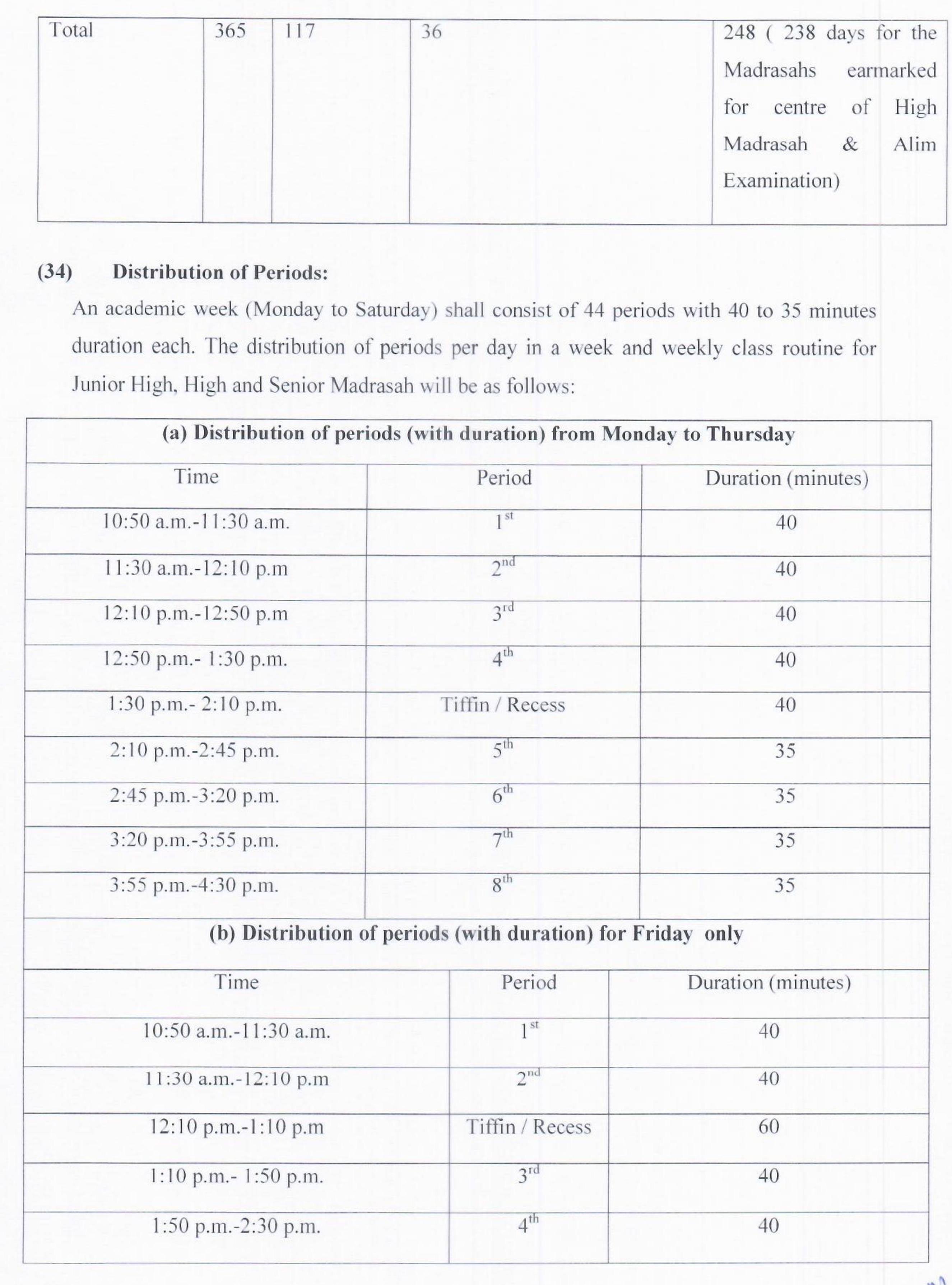
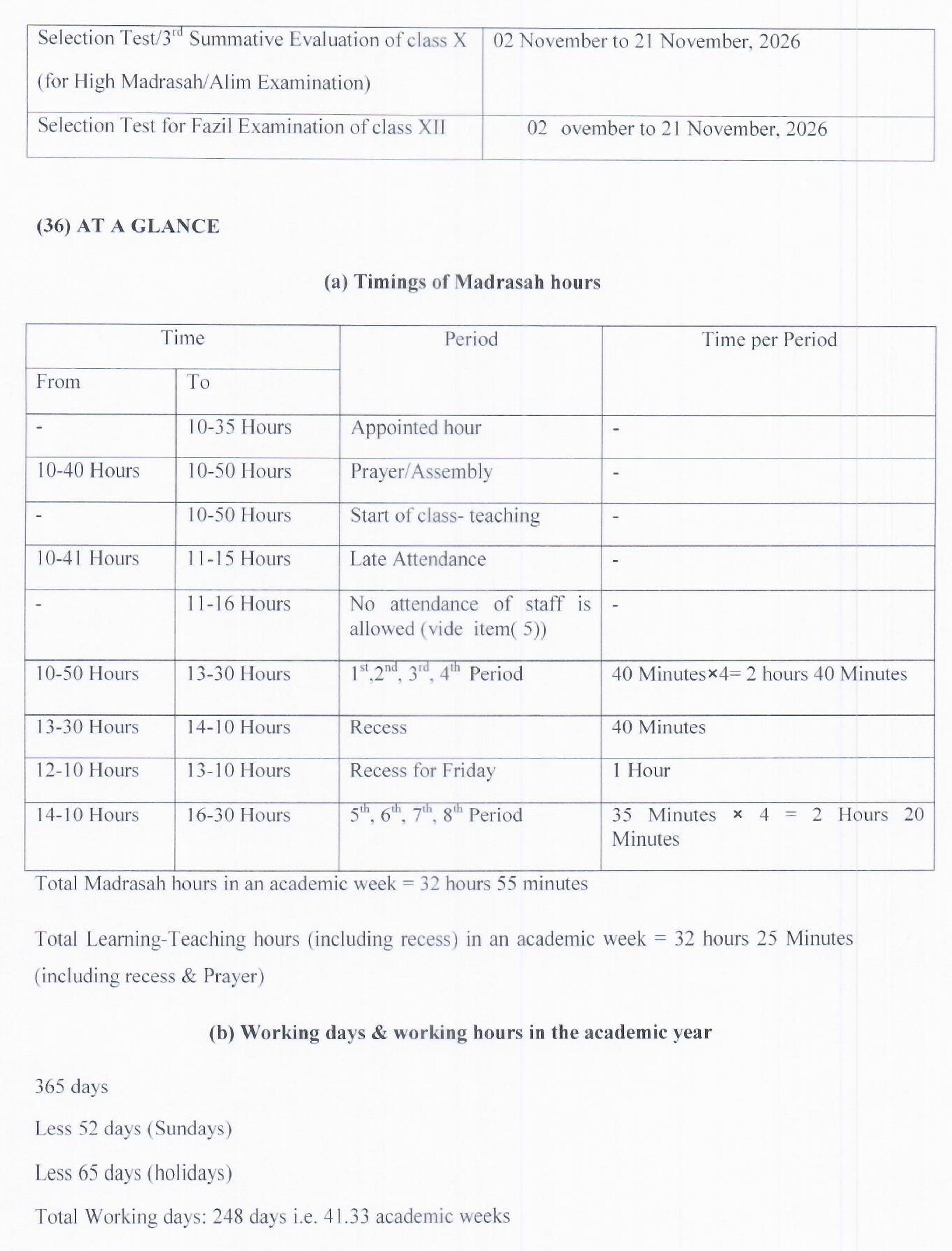
Monday to Friday: 10.35 a.m. to 4.30 p.m.
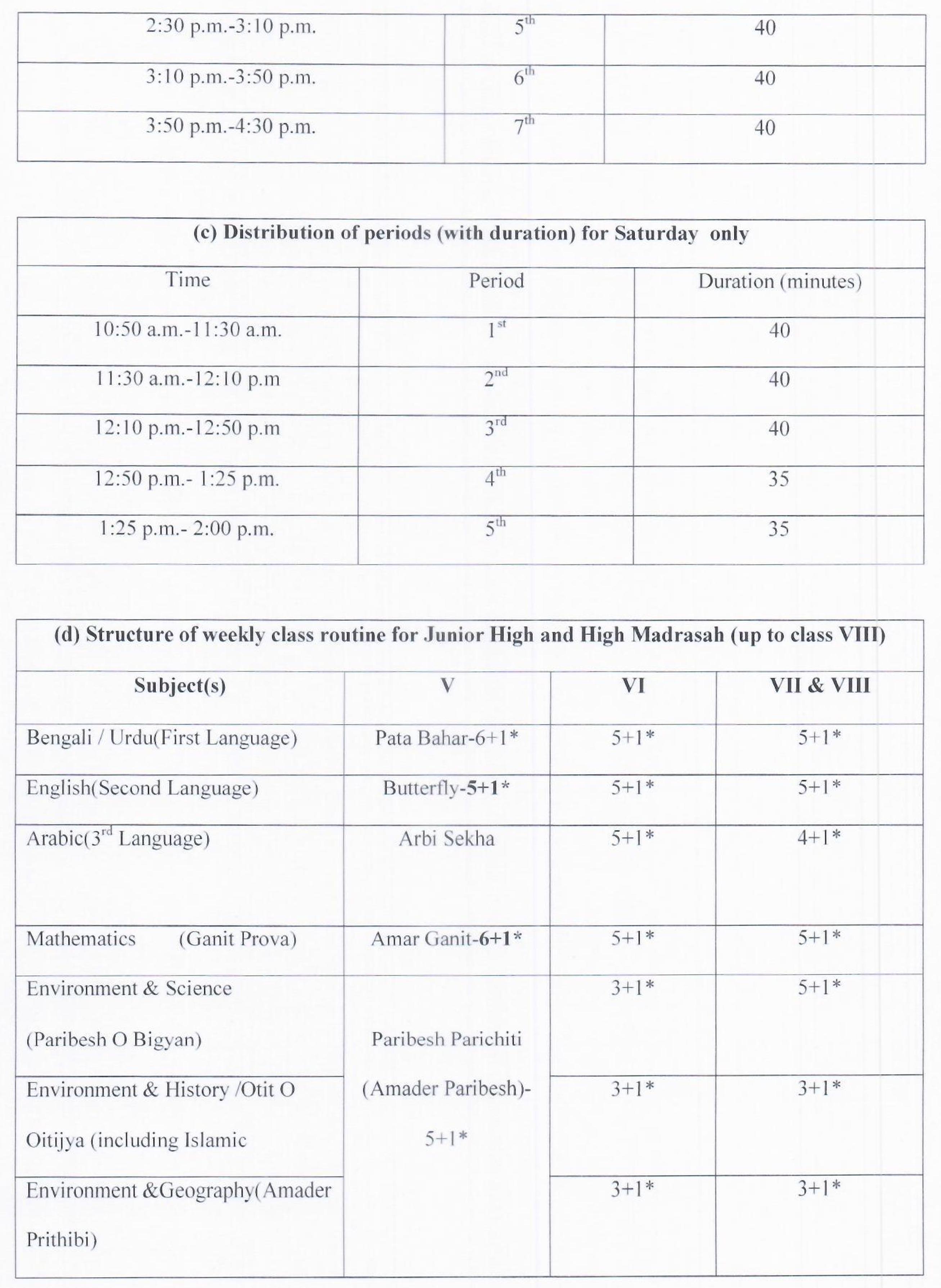
Saturday: 10.35 a.m. to 2.00 p.m.
(3) Daily Assembly:
Daily Assembly shall start at 10 (tern minutes before the commencement of class teaching (10.50 a.m.) i.e. at 10.40 a.m. Attendance in daily assembly is mandatory for all teaching and non-teaching staff including the Head of the Madrasah.
(4) Attendance:
The appointed hour of the Madrasah is at 10.35 a.m. All teaching & non-teaching staff and Head of the Madrasah shall attend the Madrasah within the appointed hour (10.35 a.m.) and not leave before the Madrasah closes for the day (i.e. 4.30 p.m. from Monday to Friday and 2.00 p.m. for Saturday).
(5) Late Attendance:
Late attendance shall be counted for all teaching & non-teaching staff including Head of the Madrasah from 10.41 a.m. & no teaching and non-teaching staff including Head of the Madrasah will be allowed to record his/her attendance after 11.15 a.m. and will be marked absent. One day’s casual leave will be deducted for even three days late attendance in a calendar month. In case the casual leave account of the staff is exhausted and the incumbent concerned comes late, he/she shall be asked to apply for one days Half average pay leave for each three day’s late attendance in a calendar month. If he/she tails or declines to apply tor such leave or it there is no such leave in his/her credit then he/she will be granted “Leave without pay” leave for each three days’ late attendance in a calendar month.
(6) Departure:
On no account, can the teaching and non-teaching staff leave the Madrasah premises before 4.30 p.m. from Monday to Friday and 2.00 p.m. for Saturday.
(7) Tiffin or Recess:
40 minutes shall be earmarked for Tiffin or Recess from Monday to Thursday. 60 minutes shall be allotted for Recess/Prayer for Friday.
(8) The Head of the Madrasah shall be responsible for overall academic and administrative matters of the Madrasah. No teacher or non-teaching staff shall remain absent without sanctioned leave or overstay after expiry of leave, or leave the Madrasah without permission from the Head of Madrasah during working hours. Heads of the Madrasahs are hereby instructed to maintain a leave register accordingly.
(9) During temporary vacancy of the Head of the Madrasah (Head Master/Head Mistress/ Superintendent), the Assistant Head Master/ Assistant Head Mistress/ Assistant Superintendent shall officiate the post of Head of the Madrasah, no other Teacher is required to be appointed as Teacher in Charge (TIC) in the said Madrasah. In case of non availability of Assistant Head Master Assistant Head Mistress/ Assistant Superintendent. TIC will officiate the post of Head of Madrasah.
(10) All academic works / activities including seminar, workshop, meeting etc. conducted by the Board and other duties relating to the improvement of Madrasah Education should be treated as urgent and fall within the bounder duties and function of a teacher/ Head of the Madrasah serving in a Madrasah. The Head of the Madrasah should allow and allot the duty of the concerned teacher to the office of the Board or the Venue decided by the authority of the Board if he/she is so invited by the authority of the Board.
(11) (i) All Teachers must attend classes allotted to them regularly and they must come to their classes on time. No teacher shall refuse the class of an absent colleague if allotted by Head of the Madrasah or Assistant Head Master/Mistress or Assistant Superintendent as the case may be. It is the bounden duty of all teaching staff to take regular and provisional classes where ever allotted to him/her irrespective of their position, keeping in mind the academic interest and welfare of the students.
(ii) Teaching staff shall perform all examination-related duties assigned by the competent authority, including setting question papers, invigilation. evaluation and display of answer scripts, preparation of Holistic Progress Report Cards (online/offline), promotion of students, admission(s), and related data entry (online/offline). Nonteaching staff shall render services as instructed by the Head of the Madrasah to ensure smooth conduct of examinations and the admission process. Any inducement by teaching or non-teaching staff that encourages unfair or dishonest practices by students shall be treated as misconduct.
(12) The Head of the Madrasah shall attend at least 10 classes per week.
(13) Distribution of text books among students shall be completed by January every year and the Head of the Madrasah (HOM) shall monitor and instruct teaching and non-teaching staff to ensure compliance. The Head of the Madrasah shall supervise and guide the leaching and non-teaching staff to ensure the smooth and timely implementation of various government beneficiary schemes for students, including the distribution of madrasah uniforms, shoes, bags, notebooks, and other related items.
(14) All head of the Madrasahs with the help of subject teachers should regularly update all sections of Madrasah Management System (MMS) Portal including website of each Madrasah and entry of marks from classes I to X by visiting https://school.banglarshiksha.gov.in/ to ensure transparency and availability of accurate information for public viewing. (Vide this office memo no. 1539/Aca/25, dated. 16.07.2025). In case of admission of students, the guidelines prescribed by School Education Department. Govt, of West Bengal, should be followed. The guidelines regarding updation of Banglar Shiksha Portal by School Education Department should also be followed. To maintain and update the MMS portal is mandatory for all teachers of recognized Madrasahs.
(15) (i) In consonance with the State Education Policy-2023, National Education Policy-2020, the ‘Bridge Course’ introduce by the Board, shall be in force until further order. The Board’s instruction as prescribed in memo no. 183/Aca/20, dated. 16.02.2020 regarding Bridge Course should be followed to implement the Bridge Course smoothly at Madrasah level.
(ii) All teachers should give proper emphasis on Foundational Literacy and Numeracy (FLN). Science Technology Engineering, Arts and Mathematics (STEAM)., Career Guidance, Life skills etc. so that students able to face the challenges of 21st century and make them eligible for upcoming job market.
(16) Even teacher or non-teaching staff shall abide by the orders or circulars issued by the concerned authority as to punctuality, regular attendance and attendance at morning prayer, taking allotted classes, completion of syllabus and other instructions contained in such orders or circulars issued by the Board or competent authority. All teaching and non-teaching staff including Head of the Madrasah shall participate in all cultural functions, Annual Sports and all co-scholastic activities etc. held within the Madrasah. Every teacher or non-teaching staff shall participate collectively and individually in national programme or events like Republic day, Independence Day. All should extend their support to the best of his or her ability in interest of joyful learning by the students and to generate a congenial atmosphere in the Madrasah.
(17) No teacher and non-teaching staff should behave on such a manner inside/outside the Madrasah a premise that is unbecoming of their post. The Head of the Madrasah. Assistant Head Master/Assistant Headmistress/Assistant Superintendent and Assistant Teachers are to take classes as per rules/orders/circulars issued by the Board or competent authority.
(18) Students are being strictly forbidden to bring mobile/smart phones inside the Madrasah premises.
(19) Teachers are being requested to refrain from using mobile/smart phones inside class rooms and laboratories during the course of teaching learning process to ensure that students’ attention is not diverted. Random use of mobile/smart phones, blue tooth devises in classes by teachers is strictly prohibited. In case mobile/smart phones need to be used as teaching aids for a particular class, permission in advance should be taken from the Head of The Madrasah.
(20) (i) Under the overall supervision of the Head of the Madrasah and with adequate involvement of the teaching staff, academic council of the Madrasah under the leadership of the Secretary of the academic council, shall review and analyse the students performance in Board Examination(s)/summative & formative assessments and adopt appropriate steps for overall academic betterment of the students. Regular meetings of academic council must be held.
(ii) The Group C and Group D staff shall execute all official duties entrusted to them by the Managing Committee of the Madrasah. The Head of the Madrasah shall ensure the same for smooth running of the Madrasah.
(21) It is mandatory to participate, as and when needed in different academic activities of WBBME.
(22) In order to ensure that the sanctity of examinations is maintained, teaching staff of the Madrasah, should under no circumstances, engage themselves in script assessing or am other activities during the course of invigilation.
(23) After the completion of 3rd summative (VI – X) and until the publication of results, the Head of the Madrasahs are being requested to use the classes for remedial teaching and arranging Co-scolastic activities.
(24) No teacher shall engage himself/herself in any sort of private tuition for personal gain as per Right for Children to Free and Compulsory Education Act, 2009.
(25) No teacher or non-teaching staff shall inflict any punishment on a student, which is barred under any law or under any order of Government. Every teacher and non-teaching staff shall extremely careful in handling student’s behaviour so that mental and physical injury to the student is avoided. Every teacher shall, if necessary, make endeavour to take correctional approach towards the students with the help of co-teachers, the Head of the Madrasah and guardians.
(26) A teacher or non-teaching staff shall, with the approval of the Head of the Madrasah, perform such duties for the conduct of public examinations other than the examinations referred to above, as may be entrusted to him/her by the concerned authority conducting such examinations. A teacher or non-teaching staff shall be entitled to receive such remuneration as may be sanctioned for discharging duties in such examinations.
(27) The Group C staff and Group D staff will execute all official duties entrusted to him/her by the Managing Committee of the Madrasah. The Head of the Madrasah shall ensure the same for smooth running of the Madrasah.
(28) Heads of the Madrasahs are hereby being instructed to maintain such an attendance register where the staff signs both on arrival and departure mentioning the time. They have also to maintain a separate record of staff attending Madrasah on ‘observable days’.
(29) No teacher or non-teaching staff shall remain absent without sanctioned leave or over stay after expiry of leave, or leave the Madrasah without permission from the Head of Madrasah during working hours.
(30) The Madrasah authority should strictly ensure the tobacco free atmosphere in the Madrasah.
(31) (i) In all recognized aided Madrasahs, teaching staff are mandatorily required to supervise and support the Mid-Day Meal Scheme on a rotational basis, including food tasting, maintenance of discipline and ensuring hygienic meal practices among students. Non-teaching staff are equally bound to assist in operational and logistical functions, such as cleanliness of kitchens and serving areas, handling utensils and orderly distribution of meals, strictly under the supervision of the Head of the Madrasah and in compliance with prescribed government norms.
(ii) Approved teachers shall work as Nodal Teachers for successful implementation of different Government welfare projects programmes/schemes such as Mid-Day Meal, Kanyashree, Sikshashree, Aikyashree, Medhashree, SVMCM, Pre-Matric and Post-Matric Scholarships, Saboojsathi, Taruner Swapna, WIFS and others for the benefit of the students as well as the society at large. Every Nodal Teacher individually shall maintain a separate register to keep the account of each project/scheme under the supervision of the Head of the Madrasah.
(32) Parent-Teacher Meet:
All Madrasahs will arrange for holding parent-teacher meet at least twice in a year and to arrange sanitization programme as & when required. All Madrasah Authorities are encouraged to form Mother-Teacher Association to stop drop-out and to enhance quality of Education. Teaching and non-teaching staff shall practice, promote and encourage collective functioning in the interest of academic and administrative efficiency of the Madrasah and shall attend Guardians Meetings when arranged by the Head of Madrasah. All staff should extend their support to the best of his or her ability in the interest of joyful learning of the students and to generate a congenial atmosphere in the Madrasah.
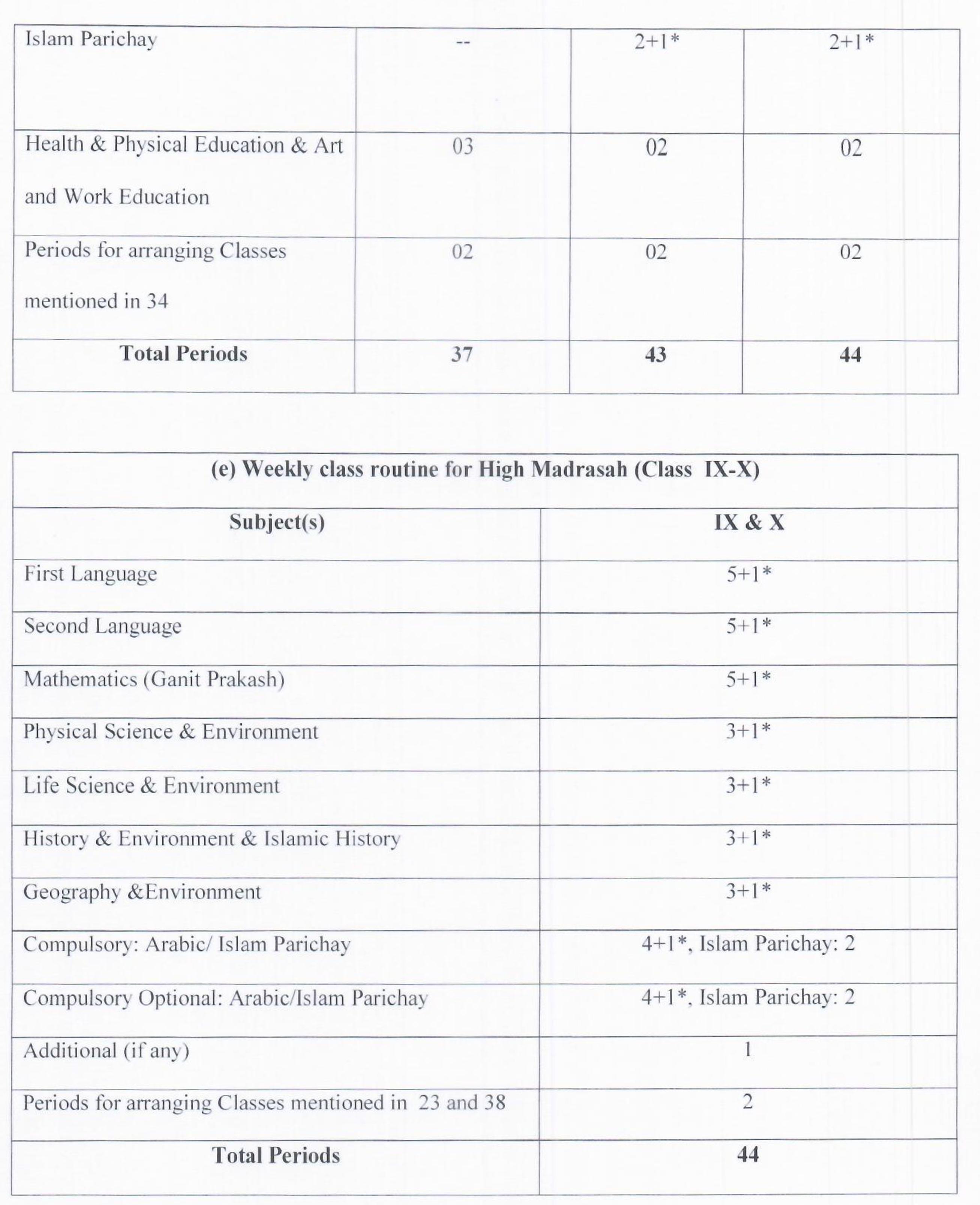
(33) Term wise distribution of working days:
(37) Supplementary to distribution of Classes:
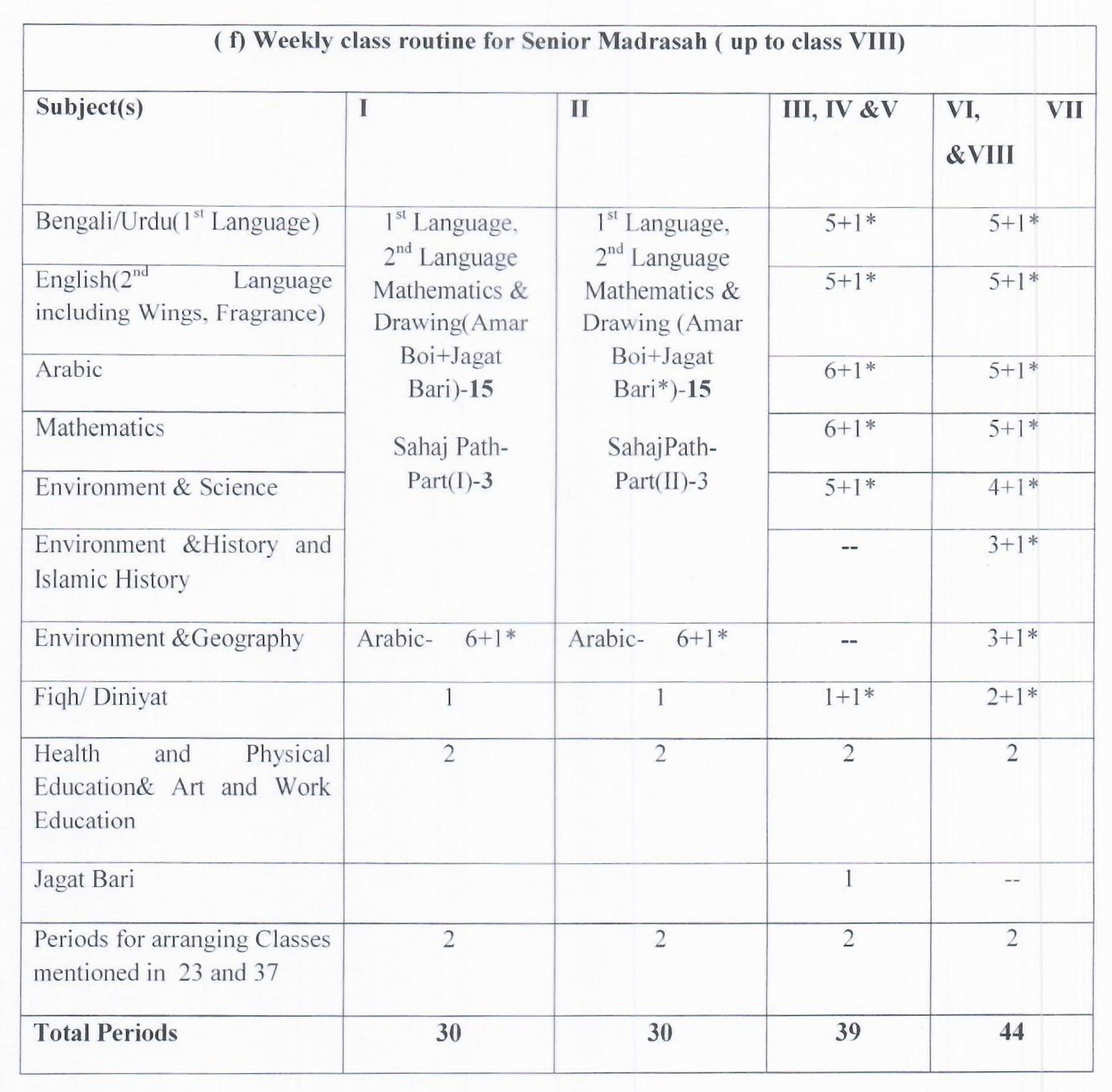
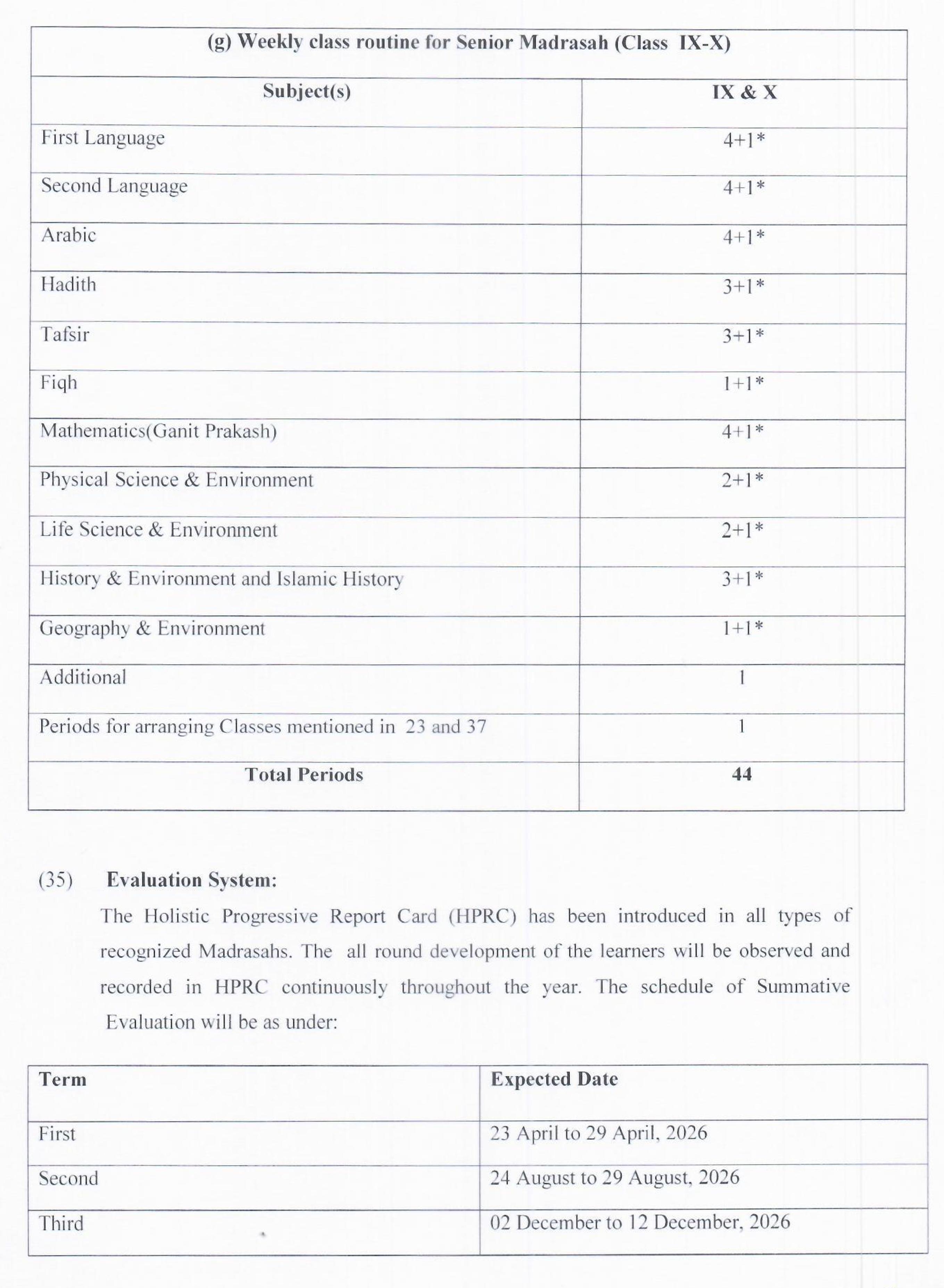
A. The classes earmarked with asterisk (*) are assigned for assessing learning outcomes as per amendment of RTE ACT, 2009. The child’s development of learning outcomes is to be conducted through formative assessment as well as summative assessment in classes I-VIII and through internal formative evaluation (IFE) in classes IX and X.
B. The Madrasah authorities are directed to make necessary provisions for arranging library class, smart class/ class through K-Yan/audio-Visual learning, Computer literacy or Laboratory based learning, awareness drives ( Kanyashree. Road safety. Child rights. Disaster management. Snake bites. Child marriage. Child trafficking, Adolescents health & hy giene, WIFS etc.) regarding curricular subjects as far as practicable.
C. The Madrasah authorities are directed to make necessary provisions for few classes for IX and X as regards the activities given alongside, information and communication technology (ICT), audio-visual learning, reference work, lab-activities/lab-based learning, Mock tests, Career counseling, Basic legal awareness/Health awareness/Skill enhancement workshops, inclusive education. Meena Manch (Girls empowerment) financial literacy etc., as applicable. The library may be used on and often for smooth execution of 1FE in classes IX and X as well as for remedial classes.
D. Maintaining teacher’s diary for ensuring formative assessment as well as summative assessment through framing of tasks, learning evidence, class record book, child portfolio on a day-to-day basis is mandatory (for classes I-VIII) for each teacher.
E. Every Madrasah has to furnish a blue print of their routine/daily time table pertaining to the mandatory structure of time periods class distribution as earmarked by WBBME. The Head of the Madrasah or Assistant Head Master/Superintendent or any Senior Teacher (in absence of Assistant Headmaster/Superintendent) Selected by Head of the Madrasah shall prepare daily provisional class routine excluding the absent teacher(s).
F. The Madrasahs will have to furnish a report to WBBME through e-mail (wbbmeaca@gmail.com) just after completion of 3 consecutive summative evaluations with proper evidences, highlighting the extent to which a child’s learning outcome has been achieved through preparation of child profiles. A copy of the same is also to be sent to D.I.S(SE)/A.D.I.S (SE)/A.I.S(SE) of concerned districts and sub divisions, as applicable.
G. In cases of classes I-VIII, the Madrasahs may afford time during effective instructional hour or may use some classes for the following activities (from classes other than subject-based learning) to develop and strengthen their learning abilities within and outside the classroom. The class teacher will incorporate and tag pertinent activities within her/his lesson design to be executed during the instructional hour throughout the academic year. Some of the activities that are exclusively co-curricular in nature (e.g. web designing, awareness drive etc.) may demand allotment of separate classes, independent of lesson design but within the stipulated instructional hours. In addition to clause 23. The teacher will incorporate the remedial classes through out the academic year.
ACTIVITIES:
- Communicative English Classes
- Computer Assisted learning (CAL) (lesson based)
- outdoor class room days/educational tour/field mobilization/population education
- awareness drives e.g. Kanyashree, Road Safety (Safe Drive, Save Life), Bullying, Child Rights, POCSO, Child trafficking, Child Marriage, Vector borne diseases with special reference to Dengue, weekly iron and folic acid supplementation, Vaccination (Rubella, Measles), Administration of deworming tablets, Cyber Crime, Disaster Management, Rain water harvesting, Planting trees, Prevention of pollution, Snake bite, Eradication of Superstitions, wild life conservation, Sanitation, etc.
- Provision for safe drinking water
- music classes (wherever applicable)
- play (drama/puppetry workshops(lesson based)
- health and hygiene camps for health awareness advocacy programmes
- group activities (an activity bank should be prepared at the Madrasah level)
- summer/winter camps
- life skill based activities
- counseling
- value inculcation
- adolescent education
- rock climbing
- global positioning system and weather forecast
- visual arts
- news editing
- content writing
- web designing
- artificial intelligence and machine learning
- preparing museum in Madrasahs based on local resources
- language Laboratory
- Math Laboratory
- Hands on experiment and basic laboratory exposure
- Kitchen gardening
- Financial literacy
- Recycling of solid waste
- Mock parliament
- Exposure visit to different fairs ( e.g. mathematics fair, science fair, health fair), museum entrepreneur centres and Govt. offices.
- Self defense
- Care of geriatric people and awareness about their rights.
- Child guidance clinic for differently abled children
- Innovative writing workshops; etc. as the need arises, to ensure a child’s social, mental and physical well being and help achieve her/his holistic development as per RTE Act, 2009 and other contemporary interventions, as and when directed by the competent authority.
- Formation of Sishu Sansad.
- Reading Habits.
- Formation of House in Madrasah
- Meena Manch
- Financial literacy
- Gymnastic Activities
Secretary
West Bengal Board of Madrasah Education